No Place at the Table

A friend recently told me a story of darting frantically around the tables at her oldest son’s wedding reception, looking for a place. Seating had not been assigned, and couples had filled up the formal tables. Since she is a widow, finding a single empty chair was not easy. Eventually a happy accommodation was made, but imagine the indignity of being the mother of the groom with no place to sit at the wedding dinner. 

One of the most honored people at the banquet, with no place at the table. 

It reminds me of our bishop after he was so unceremoniously turned out of his diocese. At a time when he should be honored for his long service, pastoral kindness, and courageous warnings about the open firehose of evil… he was ripped away from his position and his flock, and flung out like the lowliest dishwasher.

One of the most highly esteemed men in the Church, with no place at the table. 

Now we have no bishop who joins us as part of our family, though we have functionaries who fulfill the administrative duties of a bishop. No one has descended to touch our grief or bind up the wounds that must be healed to restore this local church. It’s like nothing ever went amiss, and as any survivor of abuse can tell you, that is not the path to recovery.

Our bishop now travels, bringing the Gospel and hope to people throughout the country, and the world. The Catholic laity is so starved for someone in authority to preach Jesus Christ Crucified, that Strickland has been adopted by the millions who are left shepherd-less when their bishops refuse to stand up to the wolves. 

Our bishop is living the best life possible for an apostle of the Church without a see, but his calling is to be a shepherd. That implies a flock. Not an audience, but a flock. The modern Church has forgotten that there is a relationship between shepherds and their sheep. He knows the sheep, and the sheep know his voice. The place of a shepherd can’t be filled by an anonymity.

The laity is in danger without a shepherd. Those bishops who have spiritually abandoned their posts – and that is the great majority of them in Western society – have a stern accounting in their future. But that is no comfort to us now, as we confront the Culture of Death and Disorder on our own. We need our shepherd, the one who rebukes the wolves and fortifies the gates, not just one who signs decrees.

On Tuesday of Holy Week three years ago, the Firehouse moving van pulled away, leaving me and my household goods in Tyler, where I knew exactly no one. Disorienting as it was, I was looking forward to beginning the Triduum at the Cathedral, where I assumed the bishop I so admired would be preaching, so I could hear for myself whether he was all I’d gathered from a distance.

Two days later, on Holy Thursday evening, Bishop Strickland stood in the breezeway of the Cathedral, vested for Mass, and welcoming worshippers.  He shook my hand and wished me well, on his way to the next person, but I was happily stunned. All I wanted was to hear his words; I did not expect to meet the man. 

And his preaching did not disappoint. In his bilingual homily, he slipped from English to Spanish easily, with a Piney Woods twang in both, delivering a message he clearly felt with all his heart. His whole body practically vibrated with the force of his words. 

Holy Thursday has always been my favorite liturgy of the year. That first year in Tyler, it was packed with the hope that I might have finally come “home,” after so many years languishing in parishes with no spiritual leadership, more social clubs than churches, and not even very good ones, at that.  

Since then, our bishop has shown himself a true shepherd. He has gone to considerable trouble to attend our events and talk to all the laity gathered, even to the hundreds. He knows his sheep, and even more remarkably, he wants to know his sheep. Never have I seen a trace of that attitude we know so well from other clerics, the impatience at having to herd cats. Troublesome cats, needy cats.

Rivers don’t flow backward, so I have had little hope of our bishop being restored to us. Nevertheless, I have begun to pray that he will be. Only God knows the plans He has for Joseph Strickland, but since the removal was unjust and intemperate, I pray that the wrong may be righted. 

For our bishop to be treated badly in return for good service is maddening. But for Bishop Strickland, it is a share in the degradation of the Cross. By rights, he should occupy a high place; instead, he has no place. He is Simon the Cyrenean, shouldering the Cross with Jesus. Think of the comfort Our Lord draws from his obedient son suffering without complaint! To the extent I can prayerfully, willingly, patiently endure my own sadness and anger at the loss, I participate in a minor way. 

But, dear Lord, we do miss our bishop at the table.  As we celebrate the priesthood on Holy Thursday, we will have to face a cathedra with no seal. I can’t picture it without sorrow. This Holy Week, we have a true Via Dolorosa to offer in union with Christ.

May God make it fruitful.

Shifted on The Shift

When I came out of the theatre after watching The Shift, I was only thinking one word: refund. Not so much the ticket price, but the two hours. 

By the next morning, I’d completely changed my mind. Talk about a shift. This is a movie that sticks with you. I must say, I like a movie that doesn’t give you all it has on the first date. You have to probe, you have to ponder. Probably no one was still thinking about the levels of meaning in Barbie the day after they saw it. But The Shift will continue to work in your mind, and reveal more of itself the longer you think about it. 

First of all, the movie is an allegory. Taking it literally will rob you of some of the meaning. For example, the whole idea of lives actually being lived in multiple universes at once is profoundly un-Christian. Every human is a body-person, and the life of any particular person is in that one body; it can’t be parsed. The Incarnation guarantees this integrity. 

So how can a movie conceived and produced by a Christian studio feature multiple bodies in multiple universes? The answer is that it’s an allegory, and a rich one. Each alternate universe is a picture of the world we create when we sin. As many different sins as there are, that’s how many universes could be posited. And they’re all dreary, dangerous and dull. That’s a worthy lesson about the effects of sin.

The alternate “sin world” in the movie was a perfect portrayal of the world globalists are trying to create for us: starving, demoralized people who will do nearly anything to escape the hell of daily life, including a media experience that mimics the Metaverse; storm-trooper police with reflective face shields that completely hide any semblance of humanity; crime, filth, oppression and poverty. Bibles are outlawed, as well as any mention of God. People can be arrested or shot for anything or nothing.

The potential familiarity of that hell-world was the main reason I practically ran out of the theater when the movie ended; it hit just a little too close to home, and scared me in its plausibility. Was it intentional that the world created by sin looks very much like Democrat-run inner cities?

When the movie begins, that dark world is not yet visible. The protagonist, Kevin, a man deeply in love with his wife, is targeted by The Benefactor, a slick, well-groomed man in an expensive suit whom we soon realize is the devil. The Benefactor sees qualities in Kevin that he’d like to use in his mission, but Kevin, who is at least a casual Christian, knows enough to pray when the devil is pounding at him. His prayer infuriates The Benefactor, who seems to thus be defeated, but nevertheless, Kevin is transported to that dark world of bleak hellishness that looks like an inner city in a dystopian America. (It was filmed in Birmingham, Alabama, which is, in fact, a Democrat-controlled city.)

I had to visit that scene over and over again to make sense of it. If Kevin did the right thing (pray to God) with enough fervor to anger the devil, then why is he in hell for the rest of the movie? I didn’t figure it out until the next day, because it didn’t involve sin the way I normally think of it. Kevin didn’t lie, steal, murder or commit adultery. He was a good man, a kind man. The sin he committed was subtle. 

The sin is disregard, something we all do every day. We disregard the distress of the unborn, the trafficked, the unjustly imprisoned, even members of our own families. We do it to survive mentally, to be able to go to work the next day, to function in our daily lives. We do it because we don’t believe we can survive the pain that is all around us. But what if that disregard is enough to create a hell we can’t escape?

In Kevin’s case, it was, and it shifted him to a world of emptiness and pain. No matter how many times he gave his meager food to others, or risked his life to write down half-remembered Scripture verses, no matter how many good works, he was still in hell. But he retained his humanity because of his stubborn love for his wife, and his desperate attempts to find a way back to her. Love saved him long enough that he could finally make a choice, in extremis, to undo the harm he’d originally caused. Love gave him the chance for redemption.

The dark world that Kevin is trapped in, the one that looks like where we are headed if we don’t do something quickly, is the hell we build with selfishness. The Benefactor says that clearly, in case we missed it: all sin is selfishness. We are trapped in hell until we finally make a heroic gift of ourselves to another. Perhaps the serial hells are what it takes for some of us (me) to finally be so sick of selfish choices that sacrificial love looks like the obvious and joyful way out. 

In the climactic scene, The Benefactor and Kevin word-wrestle about God and the absence of God in that dark world where Kevin is trapped. The Benefactor taunts him: why doesn’t God come? Why doesn’t God answer? It’s the classic problem of evil: where is God? 

And like any serious philosophical reflection on that question, there’s not a direct answer. God, like The Shift, and like the Book of Job which it resembles, is not an easily wrapped-up sermon in a box. Our journey to Him is hard-fought, dangerous, as if in a fog, with the outcome not certain or guaranteed. It’s a walk of fear and trembling. 

If you watch this movie, settle in for the long game. Don’t expect to love it at first sight. Let it work on you. 

Cinematic detailers will recognize Paras Patel and Elizabeth Tabish (Matthew and Mary Magdalene from The Chosen) and Sean Astin (Samwise Gamgee from The Lord of the Rings.) If you watch closely, you’ll also pick out Jordan Walker Ross (Little James from The Chosen) in a crowd scene. Neal McDonough, who plays The Benefactor, is one of the best “bad guy” character actors in the business. 

As of today, December 8, The Shift continues in theaters. It will be available on the Angel Studios app and website after its theatrical run. The production budget was $6 million, which was already recovered in the first week box office receipts. It’s rated PG and scores 87% with audiences on Rotten Tomatoes. 

To find a theater near you, watch the trailer and buy tickets, visit: https://www.angel.com/movies/the-shift

The Legacy of Bishop Strickland

It’s been a few weeks since our good bishop was taken and we are continuing to suffer “firsts.” The first Friday he was not there for Friday morning Mass and adoration, when the cathedra had already been stripped of his coat of arms and looked like it had been vandalized… that was hard.  

Tomorrow is the first monthly potluck breakfast since Bishop Strickland was taken. The First Friday potluck began when Fr. Joe was pastor, but it faltered during covid. Celeste relaunched it in the Bishop’s honor last year. Tomorrow he will not be there to bless the food, move around from table to table, talking to everyone and making us laugh.  

And the biggest and hardest first is still to come, when another bishop is assigned.  

It’s inevitable that we all thought, even if just for a moment, “What’s keeping me in Tyler if the Bishop is gone?” We moved here for the Bishop, or rather, for the way the Bishop held up Christ clearly and without making our glorious Faith subservient to political nonsense. So are we staying or going?  

We’ve drawn closer to each other, more like family as we weather this storm together. If community was rated on a scale of 1 to 10, we just skipped right over a few levels, gunning for a 10. Even that is hard, though. There’s a part of me that doesn’t want to get through this with grace, doesn’t want to find the good, as though it is somehow disloyal to the bishop to soldier on. If we can get along without him, does that somehow mean that he wasn’t vital to us? I felt the same way after my father died, not wanting to admit that my world could go on without him. 

And yet, we have to honor the Bishop by trying to be as good at what we do as Bishop Strickland is at what he does. That’s why we’ve loved him: he set an example for us, showing us how to be the kind of Catholics we want to be: bold and brave and true. Indeed, if we don’t take this adversity as a spur to grow in virtue and prayer and joy, we dishonor the Bishop.  

Perhaps there are some factions happier now that the Bishop is gone from Tyler. We can’t change that, but we can demonstrate what a difference a good bishop makes. Somehow in this time when up is down and good is evil, the witness of one humble bishop who won’t give up, has become something extraordinary. Anyone should be able to look at the laity of Tyler and see the reflection of our extraordinary bishop in us.  

The three things I think are most critical to his legacy (and it is purely coincidental that they are A, B and C) are adoration, believing the best, and courage.  

Adoration. In every diocese I’ve lived in before, Eucharistic Adoration was, at least publicly, a devotion of the laity. Rarely did I see a priest in adoration, except on Holy Thursday. When I did see a cleric in an Adoration chapel or at a Holy Hour, it was strangely exciting, like “Look! Our pastors are with us, we are not alone before the Lord!” It gave us assurance that our priests were Eucharistic, rather than worldly. Some priests have private chapels in their residences where they adore Jesus in seclusion, away from the eyes of the laity, but if they knew how significant it is to us, they might come to the public adoration chapels more often. Seeing a priest in adoration binds the laity to the priests in a completely unique way.  

We watched Bishop Strickland in Adoration every week before Friday morning Mass, and at many events and conferences. It is likely the supernatural source of our fierce loyalty to him. Yes, we like how friendly and approachable he is, we admire his forthrightness and willingness to suffer blows for the truth, but perhaps what binds us most powerfully to him is that he led us in Adoration; we came before God like an arrowhead, with the Bishop at the point. To watch him kneel on hard marble for an hour without flinching was to cowboy up and quit making excuses.  

The Bishop has his own Eucharistic chapel in his home, and had one in the Chancery office as well, but his willingness to humble himself before Jesus in front of us and as one of us, has reinvigorated my Eucharistic devotion. I’m named for a Eucharistic saint (Clare) and it was the Eucharist which brought me home to the Catholic Church; my adult life has been formed around the Eucharist. And yet, watching the bishop kneel before the Lord shakes me as though I’m encountering the Eucharist for the first time. It’s a heartrending picture of the Body of Christ. 

Bishop Strickland brought a “tiny adoration” into each celebration of the Mass, at the elevation of the consecrated Host. He stood for long moments in adoration, and implicitly invited us into adoration by drawing out the moment. People attending Mass with the Bishop for the first time would always remark on that, and I never stopped being moved by it. The elevation was often so prolonged that a person could lose himself in the contemplation of Christ and forget where he was. This was one of the great gifts of attending Mass with our good bishop. 

Believing the Best. Some people have criticized our bishop as being naïve. But I think it’s actually his willingness to believe the best about other people that is interpreted as naivete. He notably refuses to take offense at slights or even outright attacks, using humor and self-effacement to deflect anger.

The bishop’s openness to the potential holiness of every person colors his interactions, even on Twitter, where nastiness makes its home in the Comments sections. If you persistently see Christ in others, it’s impossible to demean or dismiss them. Mother Teresa notably practiced this attitude, and the Bishop is getting quite a good workout at it himself. 

You only have to watch the video of his remarks at the USCCB meeting in November 2018 to see what I’m talking about. He was clearly correct to bring up the elephant in the room (homosexuality at the heart of the abuse scandals) and clearly the bishops were aligned to do nothing about it, and yet the Bishop’s manner is open and you can see he still believes the bishops can do the right thing.  

 I have noticed a laissez-faire attitude on the part of the bishop, a willingness to let things take their course, with respect for the rights and duties of laypeople. I’m familiar with several situations in which laypeople disagreed, and went to the bishop for support of one side or the other. While the bishop might be willing to share his opinion on some matters, he respected the lay people enough to allow them to come to their own decisions about affairs proper to the laity. In this way, he forced us to mature in our thinking and charity as adult Christians in community. He would not play the autocratic father who settles every squabble for the children. He believed the best of us, and expected us to take up our duties as baptized Christians.  

The bishop is without guile, like Nathanael, but he’s no simpleton. He is, in fact, quite astute, the result of much reading and study taken into prayer. When Bishop Strickland infamously tweeted, “I believe Pope Francis is the Pope, but it is time for me to say that I reject his program of undermining the Deposit of Faith,” the phrasing indicated a process of thinking and considering. It was not said impetuously. His words, “it is time” show that he’d been wrestling with it for who knows how long, attempting, as we all have, to believe the best about the Pope. And then he couldn’t. That’s when courage came into play. 

Courage. Does anyone really believe that May 12 tweet was casual on the part of the Bishop, that it didn’t cost him dearly in his soul? It is in the deepest part of the Catholic heart to love and honor the successor of Peter, the vicar of Christ on earth. It’s not in our Catholic nature to not love the Pope. This pope has done violence to our souls by forcing us to admit that there is something desperately wrong in Rome. 

I believe Bishop Strickland knew the price he would pay for saying what he did, and had already accepted it before his fingers ever hit the keyboard. That is courage.  It may be the thing we most admire about the Bishop, perhaps because it is the hardest to emulate. What do we stand to lose that compares to what the Bishop lost for the sake of truth? Where does our duty lie? We are all called to discern our proper place in the fight for Truth. The Bishop has gone ahead of us. 

There will be a cost to speaking the Truth. We are already beginning to pay, with the loss of the Bishop, but we’re still early days. The Bishop is only part of the plan for which God brought us to Tyler. Courage will be demanded of us as we hold up the truth of Jesus Christ and His Church. This diocese, and indeed the world, is not going to fall back to some standard of normal without a crisis point. The fight is not going to pass us by. We must defend our Faith with the knowledge that there will be a cost, and we must have prayed our way to acceptance, the way Bishop Strickland did.  

The Bishop could do nothing other than to hold up the truth of Christ, which is for the good of the sheep. We must now conduct ourselves as worthy of the price. We must be as open and approachable as our good bishop, believing the best of others, pressing ourselves to adore the Eucharist at every opportunity, and speaking the truth with courage and love. 

We are the legacy of Bishop Strickland in Tyler, Texas. Let’s make it shine.  

All the best insights about moving forward come from the kind witness of Fr. Steven Chabarria.

The Good Bishop

Prayer for Bishop Strickland Unites Us

As much as the Catholics of Tyler would like to shield their beloved bishop from national notice, it’s a fait accompli. Bishop Joseph Strickland’s Tweets have attracted notice for some time, especially those that call out the evil actions of public figures who otherwise enjoy immunity from criticism. From November 2018, when Bishop Strickland prayed with the laity at the Baltimore Bishop’s Conference, befriending the faithful instead of demonizing them, we have loved him. In 2019, he stood and asserted, over the craven objections of many other bishops, that abortion was indeed the pre-eminent issue of our time. 

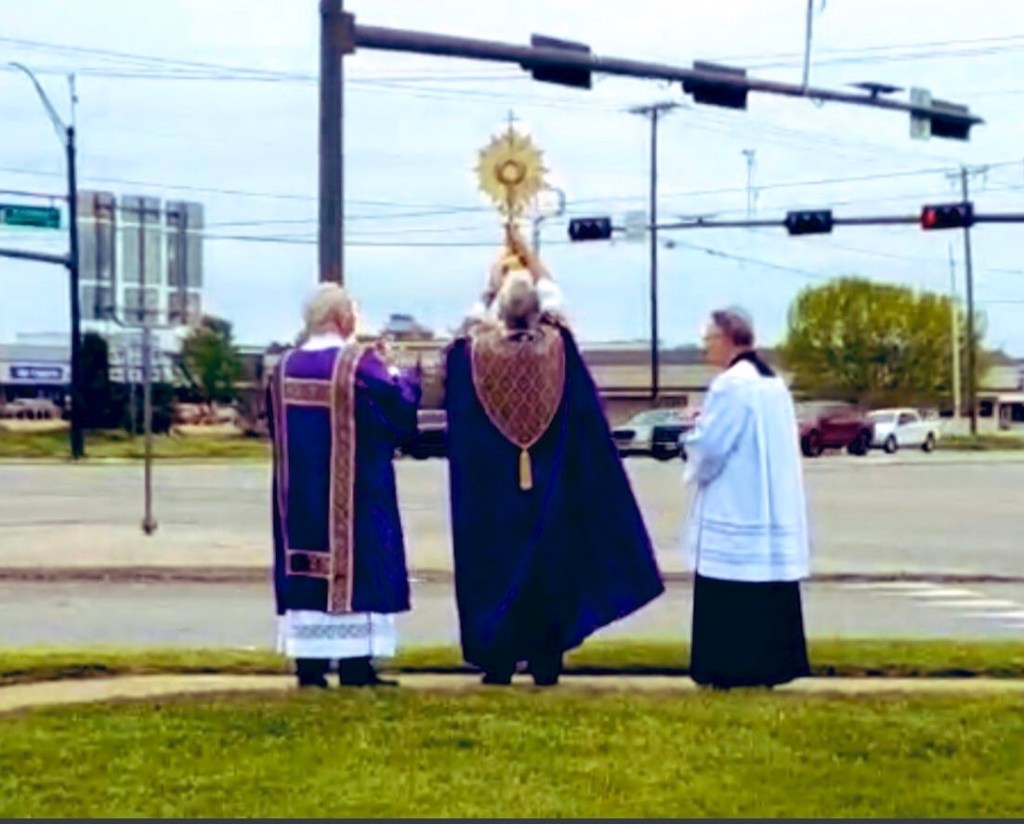
He took the Blessed Sacrament to the streets when all was shut down in 2020. He was one of the few bishops who condemned the development of covid shots on aborted fetuses. He called out Hilary Clinton for labelling pro-lifers as Taliban. 

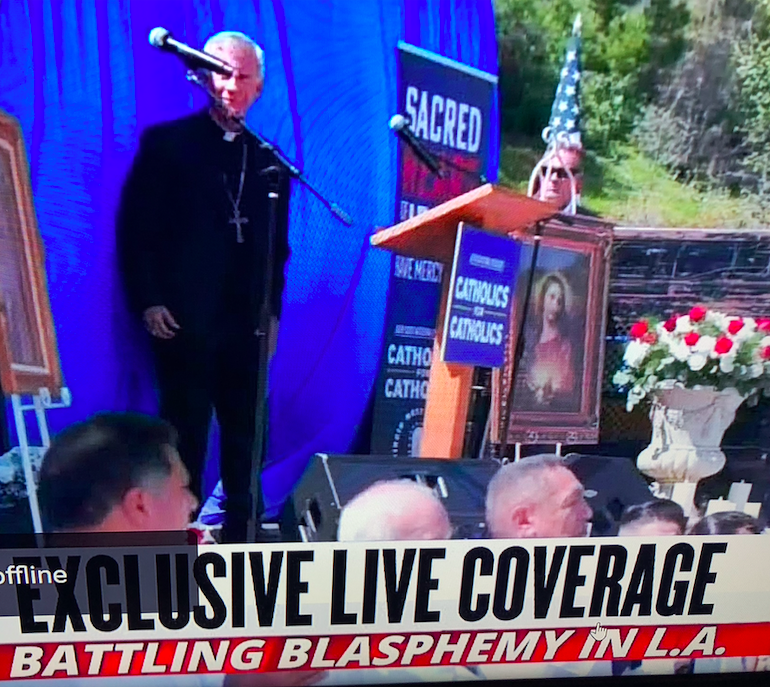
Then when he accepted the invitation to support the prayerful procession in Los Angeles outside Dodger Stadium, where the drag queen porn ensemble was going to be honored, the deal was sealed. He became the national sign of a true-blue good shepherd, which so many Catholics long for, but do not have in their own dioceses. 

Now, the action of the Vatican ordering an Apostolic Visitation has promoted Bishop Strickland even higher in the affection of the faithful. Years of frustration with poor Vatican teaching and the abandonment of the laity seem to have been distilled into a single widespread work of prayer for this one esteemed bishop. The Visitation is already concluded, but the resulting action is not yet known. You can join an organized vigil of prayer for Bishop Strickland, or pray a rosary on your own for his protection and for God’s perfect will to be done in him. It is certain that God has a plan for this loyal servant. 

In addition to the many Catholic efforts across the Diocese of Tyler, we have been made aware that the Episcopal and Baptist communities of Tyler are also praying for him. Our good bishop, and indeed, the whole local church, is being cradled in prayer. 

You can follow Bishop Strickland @Bishopoftyler on Twitter.

Our Passover Seder

Make Holy Week unforgettable.

The Cathedral Parish will celebrate the Passover Seder this year on Sunday, April 2 at 6:00 pm. 

To participate in the Seder, you must attend the Preparatory Session on Sunday, March 26 at 5:00 pm in the Cathedral Center.

Passover, the longest continually-celebrated feast in human history, begins this year at sunset on April 5, which means it falls one day before Holy Thursday. But in eternal time, Passover is always on Holy Thursday, because they are the same event: the last supper of Jesus was the Passover on Thursday evening, the fourteenth day of Nisan, in 33 AD. 

Our parish will celebrate Passover on Sunday, April 2, which is three days early and not at all kosher! But since we’re observing the feast as Christians, we can take liberties. 

The date of Passover is governed by the law given in Exodus 12: “Tell all the congregation of Israel that on the tenth day of the month of Nisan, they shall take, every man, a lamb… and they shall keep it until the fourteenth day, when the whole assembly shall kill their lambs in the evening.” The month Nisan is “Abib” in Hebrew, which means “green ears of grain,” an obvious reference to Spring.

So Passover is always on the first full moon of Spring. It had to be a full moon; God would not have sent the whole nation of Israel on a night march with no light. Spring begins at the equinox, March 21, the day on which day and night are equal in duration. After the Equinox, the days get longer… and that is Spring! The first full moon after the Spring Equinox falls on April 5 this year.

Have you wondered why the date of Easter changes from year to year? Easter is set as the first Sunday after the Paschal full moon (Passover). It’s what is called in the Church a “moveable feast” and the dates of those feasts for the coming year are read every year at the Mass of the Epiphany.

The three pilgrim feasts of Israel are each associated with an agricultural season: the barley harvest around Passover; the wheat harvest around Pentecost; and grapes in the fall around the feast of Tabernacles. Yahweh required that the men of Israel should journey to worship at the Jerusalem Temple on those three days. 

That’s why Jerusalem was so packed with people on Palm Sunday in 33 AD, when Jesus rode into the city on a donkey; it was the tenth day of Nisan. Jews from all over the world had to be in the Holy City for the pilgrimage feast, to procure a lamb without blemish for the Passover sacrifice four days later, on the fourteenth day of Nisan.

In essence, Passover is the memorial of that miracle by which God saved the people of Israel from bitter slavery in Egypt. He brought them through the ten plagues which struck Egypt, but left Israel unharmed, then led them through the Red Sea on dry land, toward the land that had been promised to their fathers. Miracle upon miracle upon miracle!

Despite the cartoon movies that have been made about the Exodus, the plagues were truly frightful. The food crops of the Egyptians were completely destroyed, their animals covered with boils and infection, the waters of the great Nile river turned to blood, the light of the sun was extinguished, and finally, every Egyptian first-born was found dead in his bed. 

Try to imagine the complete contamination of our water, all our wealth destroyed, no food to be had, and the sun withdrawing its warmth and light. Wouldn’t you pretty much agree to anything at that point? But no, Pharoah continues to hoard his power over his slaves, until finally the death of the Egyptian children breaks him down. He practically begs the Israelites to leave his country. But after they’ve left, he changes his mind again and goes after them. It is a drama about evil and its persistence; evil will risk even its own destruction to stay in power.

At churches all over the country this spring, Christians will celebrate the Passover. It has become a popular “living Bible study.” But for Catholics, it has the most poignant meaning because we have been celebrating the Passover our entire Catholic lives, mostly without realizing it. 

All our lives, we have heard the “Paschal Mystery” proclaimed: the suffering, death and resurrection of Our Lord Jesus. “Pascha” is Greek for Passover. We’re about to hear that word much more often, throughout the Easter season. In the Sequence on Easter Sunday, we will hear proclaimed, “Christians, to the Paschal Victim offer your thankful praises!” The Alleluia verse will be, “Christ, our Paschal Lamb has been sacrificed.” All the Easter prefaces will refer to “Christ, our Passover.” He is the Paschal lamb, the Passover sacrifice.

And so to learn more about Passover is to enter more deeply, more consciously into the Passover sacrifice of Jesus that we celebrate at every Mass. 

When Catholics encounter the Jewish celebration of Passover for the first time, there are flashes of recognition, gasps of wonder. Because what Yahweh commanded to Moses 3000 years ago is what we say and do at every Mass. 

It’s like discovering ancestral stories that give you a clue about how you came to be the way you are. My grandmother grew up at switching stations on the Santa Fe railway, and now my heart goes thump whenever I hear a train whistle. My grandfather was Irish, and the sound of Celtic flutes makes me cry.

When Catholics celebrate the ancient Passover rite, with words and actions that are part of the fabric of us, we are suddenly whooshed into the 3000-year river of salvation history. We encounter the proof of God’s eternal plan, set into motion in antiquity, still alive today.

As the Cathedral Parish celebrates Passover this year, watch and listen for all the prayers and gestures that you are so familiar with.

In the Old Testament, God is very particular about the way in which He desires to be worshipped. He is very specific. The lamb must be a year-old male, spotless, with no broken bones. The bread must have no leavening agents. The herbs must be bitter. The celebrants must tuck up their tunics, and be ready to travel. 

And the blood of the spotless lamb must be sprinkled on the doorposts of the houses of Israel. Skepticism or disregard of this command resulted in the death of the oldest child of the household, and even the first-born of the animals. There were no innovations, no nods to the spirit of the times. The people must do precisely as God commanded.

It’s part of God’s divine pedagogy, that is, His way of teaching. His ways are incomprehensibly glorious; we can’t understand them at first glance. So God has to prepare His people to receive His plan.

All the steps God took with Israel were “teaching moments,” no matter how bizarre they seemed. The unbelievable command for Abraham to slaughter his long-awaited, only beloved son? It was a teaching on the radical nature of the sacrifice that would be required to save us. That strange and not-so-appetizing manna that fed the Israelites in the desert? Preparation for the day that Jesus would tell his disciples they had to eat His flesh to have eternal life.

You could practically trace the whole story of salvation through bread. Melchizedek, the primordial priest, brought out bread and wine to bless Abram, the chosen of God and patriarch of Israel. When God issued His precise commands for the building of the temple, He commanded that “the bread of the face” must be before the Holy of Holies at all times.  The Savior was born in Bethlehem, the “house of bread” in Hebrew; Jesus multiplied bread for the crowds following Him. He delivered a difficult-to-swallow teaching on the bread of life, and He blessed the bread of the Passover to show exactly what He meant by those words. 

An even richer history could be taken through the figure of the lamb, from Abraham’s substitutionary sacrifice, to the daily sacrifice at the Jerusalem Temple, and the entire symbolism of the Lamb of God, the Lamb that was slain but not dead, who appears at the Throne of God in Heaven. 

And consider wine: commanded by God for the joyful feast days, Jesus’ miraculous changing of water to wine at the beginning of his ministry, the four cups at wine at the Passover supper, the chalice of the New Covenant consecrated by Jesus.  

Passover brings all those threads, bread, wine and the lamb, together in one grand event, commanded by God as an everlasting ordinance. The long millennia of celebrating Passover was the key that allowed the apostles to, finally, understand Jesus’s enigmatic words about eating His flesh and drinking His blood. 

Passover plays the central role in God’s divine schooling, preparing us for the sacrifice of the Eucharist. At every seminal moment in Israel’s history, the Passover was front and center. The original Passover was the evening before Israel was delivered from slavery. When Israel finally entered the holy land, they celebrated Passover. When the exiles returned from Babylon to rebuild the temple in Jerusalem, they celebrated Passover. When Jesus remained behind in Jerusalem for three days, to the consternation of his parents, it was Passover. When He multiplied the bread, it was Passover. Passover is the key. 

The central place of the Passover in the life of Israel has flowered into the central place of the Mass in the life of the new Israel. So much preparation, so many millennia of teaching, all so that we would understand Jesus’ gift to us at the last Passover of his earthly life. God has been preparing us for the moment of Communion for thousands of years. Passover is that preparation.

This year, make your Holy Week unforgettable with the Passover Seder.

Join us this year on Sunday March 26 at 5:00 for the preparatory session and on Palm Sunday, April 2 at 6:00 pm for the celebration.

CORAC Field Day

Saturday, November 5 from 8:00 am to 8:00 pm

Register here: https://coracregion8.ticketleap.com/field-day/

Homesteading skills are pure gold, allowing us to live more independently and closer to the land, but these skills are no longer being passed from parent to child. If we don’t make the effort to reclaim them now, we might become the first generation of Americans who don’t know how to bring in a crop, dress and prepare game for dinner, and preserve summer’s bounty for the winter.

Join us in recovering some of these simple living practices. CORAC (Corps of Renewal and Charity) will present a Field Day of homesteading skills and inspiration on Saturday, November 5 from 8:00 am to 8:00 pm. 

The day will include keynote speakers Charlie Johnston, founder of CORAC, and Mother Miriam of the Lamb of God, as well as experts in the areas of radio, fish and game, gardening, food preservation, water sourcing, foraging, raising poultry, home defense and more. There will be demonstrations and availability of experts for questions.

THIS WILL BE A WORKING DAY, WITH MANY DEMOS AND LIVE INSTRUCTION. 

Event goes on, rain or shine. All talks and demos will be outside, under tents. The ground is unpaved so wear appropriate footwear. Since preparedness is the objective, you will be practicing self-sufficiency by bringing your own chair, refillable water bottle, snacks and layered clothing. Lunch and dinner will be provided, but anyone with dietary concerns should consider brown-bagging. Mass will be celebrated during the day.

Location is a family farm in Lindale, TX. Specific address and further details, as well as a schedule of presentations, will be sent to registrants by October 23.

Registration is $20 for CORAC members, $30 for non-members and $40 for all registrants after October 20. We respectfully request that you not bring children under the age of 12. It’s going to be a long day, and there are hazards for children on the property. Children over age 12 register at the same price as adults. 

If you’re not yet a CORAC member, consider joining. There are many benefits, and it costs nothing but your goodwill and readiness to embrace the mission of acknowledging God, taking the next right step and being a sign of hope to others. Read more about CORAC membership here: https://truthforsouls.com/2022/06/10/what-is-corac/ or visit the CORAC website at: https://corac.co

Registration for Field Day is open to all, whether or not a member of CORAC, but we’d love to have you join us. In any storm, the stronger the community, the better.

Sheryl Collmer is the regional coordinator for CORAC East Texas. You can reach her at: sherylc@coracusa.com.

Milestone at Veritatis

Masses Begin at Veritatis Splendor

First Mass in the Chapel of the Holy Family

With the debut of daily and Sunday Masses at Veritatis Splendor, the idealistic community up in Winona has sprung back onto the radar screens of east Texas Catholics. For a while, people wondered if the intentional Catholic community would die a quiet death from having bitten off too big a bite. Neighborhoods, schools, recreational facilities, a High Italian Gothic-style church… I mean, really! Somewhere north of nowhere?

But a steady tide of building activity has been going on all year, and there are some days that the property looks like a giant anthill, trucks and flatbeds plying back and forth as pipe is laid, foundations poured and building materials delivered. Infrastructure to support the first phase of neighborhoods is near completion, and lot owners have begun constructing and living on their properties. And now, the opening of the Chapel for public Mass is a major milestone in the life of Veritatis Splendor.

Fr. Stephen Thompson, main celebrant and homilist at the opening Mass

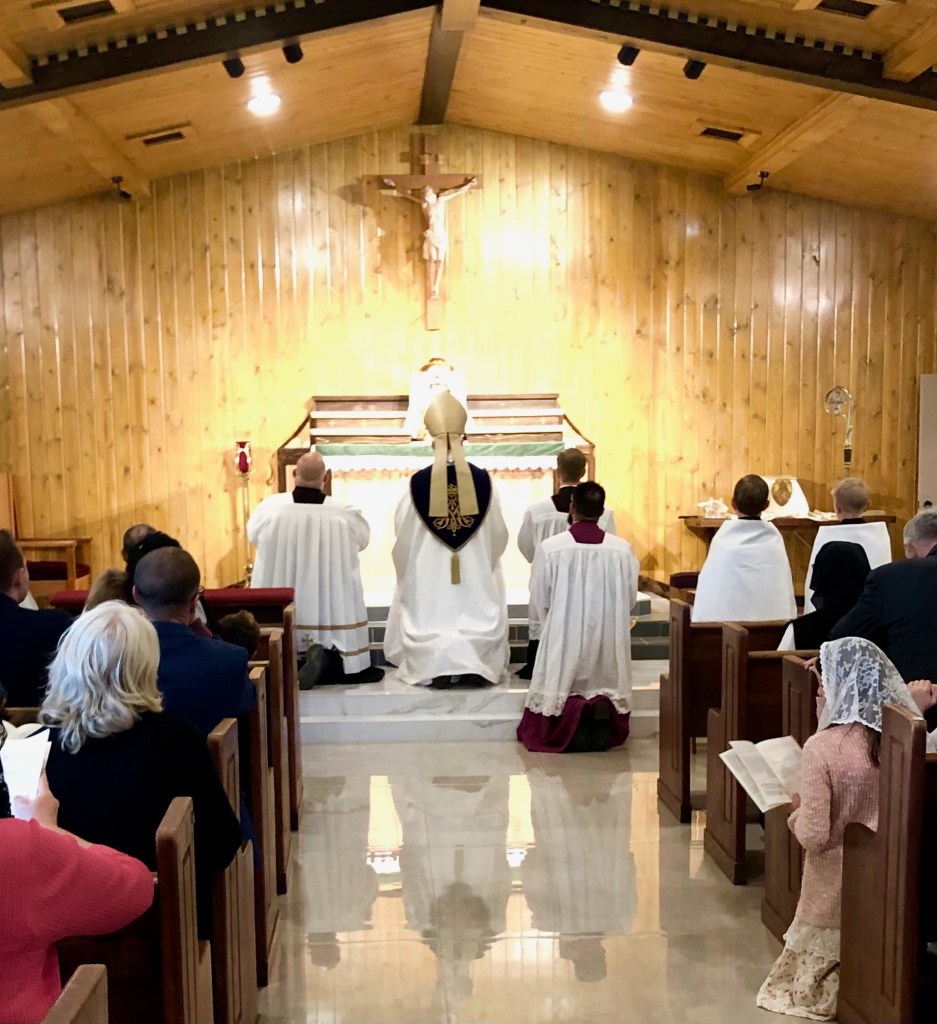
The Holy Family Chapel was completed last month, and the first Mass was celebrated on September 29, the feast of the Holy Archangels, with Bishop Strickland present. The chapel is small, to tide over the worshipping community until the magnificent Oratory on the Hill can be built, still some years in the future. The chapel seats around 50, with overflow seating for another 50. It’s a church-shaped building, constructed within a larger metal barn. It reminds me of the Holy House of Loreto, the tiny cottage where the Virgin Mary was said to have conceived of the Holy Spirit, which is now enclosed within a much larger basilica.

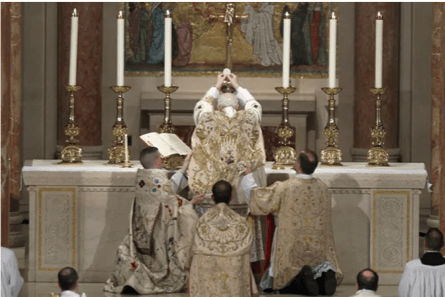
The Chapel is very much a “country church” with stained pine walls and aged wooden pews, with elegant highlights in the trim of the roof beams, the lovely fixtures reclaimed from older churches, and of course, the tabernacle of the Blessed Sacrament. It is a humble and amiable atmosphere in which to celebrate the Mass, including the Ordinariate Use of the Roman Rite.

The Ordinariate has captured my imagination. Ever since Pope Benedict’s expansion of the use of the Latin Mass in the 2007 Summorum Pontificumand especially the constriction of it by Pope Francis in Traditionis Custodes of 2021interest in the Latin Mass has blossomed. What is this rite by which nearly all our saints and ancestors were saved? What drove the process that changed it? Have we lost something we ought to preserve? 

More and more people want to find out for themselves, but the Latin Mass can be intimidating for those who came of age after the 1960s. It is differentand requires a bit of orientation and practice to feel confident in its celebration. 

The Ordinariate Rite is like a stepping stone to the Latin Mass. It is a beautiful liturgy with its own rich history, whose roots in the Catholic past have not been disturbed. I sometimes explain it to people as “the traditional Mass rendered in English.” The Fathers of the Pious House, who make their home at Veritatis, readily agreed to train and offer the Ordinariate. It is a new leaf in the folio of Catholic worship opportunities in east Texas.

Generically, “ordinariate” refers to an ecclesiastic organization led by someone other than the local bishop. When Anglicans began to embrace the Catholic Church in large numbers several decades ago, dialogue began between Pope Benedict and Anglican clergy. Whole Anglican congregations and dioceses wanted to become Catholic, without losing the rich patrimony of the Anglican church. They had preserved beautiful architecture, music and liturgy for their worship, and many could not bear that it be lost, to be replaced with stick-figure art, singsong music and modernistic architecture, the puerile aesthetic that had taken over many Catholic parish churches. 

Then Pope Benedict issued the exhortation Anglicanorum Coetibus in 2009, which allowed for the full communion of Anglicans with Rome, while retaining their own hymns, art and liturgy. These formerly-Anglican congregations were known as “ordinariates” and their liturgy, as the Ordinariate Use. 

The Anglican and Roman rites have a common ancestor, of course: the traditional Mass which was largely unchanged from the 3rd century until the 1960s. The Novus Ordo created some new things and jettisoned some old ones when it was promulgated in 1969, but of course, didn’t affect the Anglican Church at all. So the liturgy permitted to the Anglican Ordinariates, even after full communion with Rome, is essentially the Traditional Mass, rendered in English. 

The Mass schedule of the Holy Family Chapel gives us ample opportunity to explore our heritage in the Mass, both in Latin and in English. The Ordinariate is celebrated on Sundays at 8:30 am. Other Masses available during the week are Sundays at 10:30 am, Monday – Friday at 12:05 pm, and Saturdays at 9:00 am.

The drive from the Cathedral in downtown Tyler to the Veritatis chapel is 25 minutes into beautiful rolling hills and stands of pine. When you’re there for Mass, take a look around at the vision-becoming-reality of the Veritatis project. Remind yourself that, with perseverance and God’s grace, even dreams that people scoff at, that stumble on obstacles, that seem too good to be true, can indeed be realized, bringing something new and fresh into our lives.

Holy Family Chapel 

16711 County Road 356, Winona

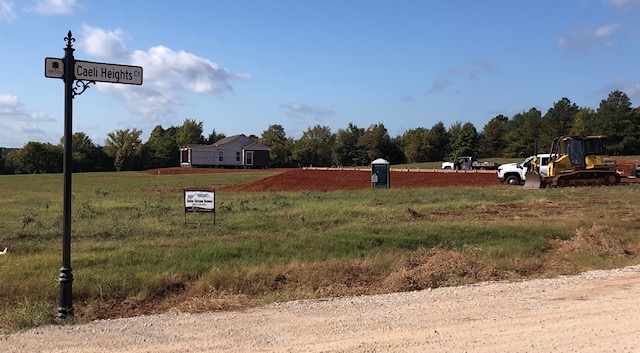
The neighborhood at Veritatis Splendor is growing.

Mordor Is Come

Gandalf: The board is set… the pieces are moving. 
The fate of the world will now be decided.

Like Sauron’s army spilling out of Mordor, Satan has come out in our lifetime. He has dispensed with the glamour phase of human recruitment, and has moved into the brute force phase. No longer dangling shiny objects in order to attract innocents, he is out in the open. 

See how Satan once disguised abortion as health care, as compassion for women. He seduced those of decent intent who merely lacked critical thinking skills, and sucked them in. When they didn’t fight, evil overcame them. Now, abortion advocates carry signs that say, “Abortion = Good Snack.” Satan is confident enough of his servants to drop any pretense of civility. 

In the Lord of the Rings, Sauron committed all his assets in one final play for domination of Middle Earth. The current axis of corrupt government, tech giants, the disciples of the demonic World Economic Forum and World Health Organization, and the complicit media is Mordor. 

Saruman: Together, my lord Sauron, we shall rule this Middle Earth. The old world will burn in the forest of industry. Forests will fall. A new order will rise. We will drive the machine of war with the sword, and the spear, and the iron fist of the orc.

The great question is: will we fight? Will the world of men stand up, or be boiled alive like frogs in a pot? Do we have the courage of intrepid hobbits who, with the thinnest, most tenuous hope of success, set out for Mordor to destroy the Ring? 

Theoden: How did it come to this?

The darkness has been lowering for many years now, slowly enough that it seemed normal, though it was filled with evil. Was there ever anything normal about random promiscuity and the circumvention of God’s great gift of procreation, and the extermination of any little human who slipped through the sieve? Is massive corporate farming using toxic materials normal? Is the weaponization of health care normal? Pornography? Pedophilia? The manipulation of psychically weak personalities to carry out evil agendas? 

We’re not longing for what we once called normal; we’re longing for what normal should have been. We’re longing for the Shire, for cozy homes with happy children, good food and ale, tilled earth and green growing things, music and dancing, and above all, a community that held together through generations. We are longing for a world of goodness and love, not that old world we used to call “normal.”

Consider the endgame now evident: the worldwide medical destruction caused by an engineered virus, the dangerous shot, the excess mortality rates in working age people, the organized shutdown of viewpoints that differ from the approved narrative; the hemorrhaging of US funds to foreign powers, the planned instability at our Southern border, the manufactured food shortages which are only in the beginning stages, the dangerous biolabs placed around the world by a US shadow government, the targeting of children in their innocence, and the perfidious media deliberately hiding it all.

In fact, the media is the lynchpin of the whole enterprise. The media runs cover for Mordor.

And the endgame is intensifying. Governments are rolling out a digital identity system that will control behavior and spending. New bioweapons are being revealed, to suck in the unthinking. Children are assaulted on every possible front. If evil were a game of Jenga, we would be nudging the last remaining block that holds the tower up.

It won’t be enough to flee the cities. Mordor is advancing, like a flood of poisoned waters. It will reach everywhere if we don’t stop it. 

Pippin: Maybe Treebeard’s right. We don’t belong here. It’s too big for us. What can we do? We’ve got the Shire. Maybe we should go. 
Merry: The fires of Isengard will spread. And all that was green and good in this world will be gone. There won’t be a Shire, Pippin. 

The media makes excuses for all the things that are purposefully being done to us, but even the most willfully blinded people know something is off. It’s like downshifting on a hill; you can feel the change in Satan’s energy. Anyone who hasn’t realized it yet undoubtedly will, if diesel runs low and our food supply is short, if groceries can’t be bought without digital identity, if witches take over the public square and the attacks on our churches heat up in earnest, if the government arrests a critical mass of people for holding unacceptable views. The warning signs have been posted. 

None of this is stupidity; it’s not party politics or conspiracy theory. It’s Sauron releasing the Orcs. 

The Orcs are in every major institution of the world. While we raised our families, worshipped our God, and found joy in the created world, Satan was planning, and placing his minions in influential positions literally everywhere. This is a huge, coordinated machine we’re up against. 

Evil has no love, no pleasure in simple things, none of what gives human life its sheen; it is not distracted from its one purpose. That’s why Jesus warned us that the children of darkness are more shrewd in their dealings with their kind, than the children of light are with theirs. Darkness doesn’t rest, even when we must.

So we must rise united, ready to shore each other up; we must forgive each other’s faults, and allow nothing to come between us. No one of us can fight this battle alone.

Elrond: Strangers from distant lands, friends of old, you have been summoned here to answer the threat of Mordor. Middle Earth stands upon the brink of destruction; none can escape it. You will unite, or you will fall.

Every day, more people realize that there is a plan, not a hash of unrelated disasters. Every time a complicit news outlet is compelled to reveal a fact previously hidden, every time a bought politician has to backpedal to save his skin, every time one person decides to stop complying with the madness, it’s like a light switched on in the middle of the night, sending the cockroaches scurrying. These skirmishes show that the battle can be won. Don’t listen to those who say, “It’s too big; we can’t win.”

We can win. Middle Earth wasn’t saved by the hobbits who hid in their holes. It was saved by those willing to leave, to make sure their home would survive. We must come up out of our semi-comfortable lives. Understand that Satan has committed unimaginable assets to this battle, perhaps all his assets. It is both his strongest and weakest moment. We have a chance for a decisive victory, but it will take all of us. 

Gandalf: Men are not as weak as he supposed. There is courage still, strength enough, perhaps, to challenge him. 

He will not risk the peoples of Middle Earth uniting under one banner. 

How we will fight is not as essential as determining that we will fight. We will figure out the logistics later, but we must first decisively show up to the battle. We will not hide ourselves from painful facts. We will not believe media rationalizations without investigating. We will not take refuge in junk movies and video games to escape the realization of the grave danger we are in. We will not bite back the truth for fear of repercussions. We will not turn our faces from evils that make us sick to our stomachs, as Jesus did not turn from evils so hideous that He sweat blood in contemplation of them. 

Prayer is the foundation of all we do, but prayer alone is not enough. God has placed us here, now, to fight this battle. All heaven is watching, all the faithful gone before us, all the thrones and dominions.  Can you imagine how the great saints would have loved to live in this time, deemed worthy to fight for the Good?

It is time for us to unite under one banner, the hosts of the Lord, and destroy Mordor. 

Aragorn: This day we fight! By all that you hold dear on this good earth, I bid you stand, Men of the West!

Christians, come out!  The army of the Lord is moving.

All quotes: imdb.com
Image: Memegenerator.net

What is CORAC?

CORAC is the Corps of Renewal and Charity, created in 2020 to help people be ready for the storm we could see on the horizon. There are members across the United States, organized into geographical regions, so that everyone has a local group, as well as access to national expertise and support in communications, health and wellness, sustainable living, crisis scenarios and prayer.

The ethic of CORAC is simple: acknowledge God, take the next right step, and be a sign of hope to others. This credo has already gotten me through some hard times. It distills all the noise and fuss down to something anyone can do. 

For people who may be isolated in leftist parts of the country, CORAC provides a forum of like-minded people of faith, so that no one need feel alone in their convictions.

CORAC team leaders have spent over a year building an infrastructure so that in a crisis situation, we would have resources already at our fingertips, ready to deploy, as well as plans thought out in advance. For example, the crisis scenario team has protocols and checklists for a variety of possible emergencies posted on the website, and ready for each family to print out and have on-hand. That team also has a communication plan to deploy in case of emergency.   

One plan relies on a national network of HAM radio operators to get communications out to each member.  The hub is a mega station in the Dallas area, and that particular operator is networked into Bishop Strickland’s ham network for the Tyler diocese.

There are resources on the website for anyone who is not yet certified as a radio operator but wants to get equipped, as well as practice sessions for those who are just listeners on shortwave radio.

The health and wellness team consists of conventional physicians, homeopaths and herbalists. They review protocols for safety and accuracy, and publish those that deal with current health issues; for example, strategies to deal with vaccine injuries, ways to stay healthy through the cold & flu season, medicinal herbs that you can find almost anywhere. Much of what is on the website consists of solutions to problems we might encounter if conventional medicine was not available.

My sister in Kansas had a very bad case of covid last year, and could not get proper treatment in her little town, being unvaxxed. She finally called an MD in the nearest city, who was able to help her enormously. By sheer coincidence, that physician was a CORAC member. Now that doctor is my sister’s regular physician.

The national reach of CORAC has allowed members to find trustworthy doctors in other parts of the country for our family members who live far away. For example, one family here in Tyler had a relative in Illinois who was in serious trouble with covid. The hospital in that area would not treat him. I was able to call the regional coordinator for Illinois, and get a recommendation for a real doctor (one who cares more for the patient than the government) who prescribed the proper medications and got him on the road to recovery.

The sustainable living team deals with such things as farming and gardening, sanitation during emergencies, foraging, canning and preserving food. They do periodic Zoom classes that are recorded and then posted on the website, along with the notes in PDF form.

The prayer team has a national network of people who are actively praying for the monthly intentions of CORAC, as well as an ongoing Catechism class with Desmond Birch, one of the foremost eschatologists in the Church today.

The prayer team is also in charge of the network which will swing into action in a crisis, and match members who want to check on their out-of-state family members, to CORAC members in that area. This network is still being built, but I was able to access it in February when I had a friend who was terribly sick and stranded in Montana. He’d gone to two ERs for help, and neither one treated him. I called a CORAC member in Montana, who got prescriptions and food to him, as well as a priest who anointed him. (He’s fine now, thanks to that CORAC member.)

That’s the power of having a national infrastructure.

CORAC Geographical Regions

At the local level, it’s up to us to draw people in and build the supportive kind of community that will be like gold if there is a breakdown of any kind. This could look like foraging walks with a group, everyone identifying different plants and taking cuttings or samples. It could be a canning tutorial where all the participants bring fruit and learn how to preserve it safely. It could be a meeting of people bringing their shortwave radios to a central spot to practice tuning. It could be a workshop of emergency medicine, like bleeding control and triage techniques.

In a technology blackout or genuine emergency, we will all be hyper-focused at the local level, by necessity, so it’s important to build relationships and skills within the local groups. Access to national expertise may also be helpful for any knowledge gaps in the local groups.

There is a plan in every town where there is a CORAC member, to meet at the local parish church at 9:00 on the Saturday morning following any multi-day communications blackout. This is our strategy to share information, as well as to seek out those who may need special help.

There is no cost to join CORAC, and some materials on the website are only available to members. In addition, members receive a biweekly newsletter with news items, inspiration, tips for action, and links to helpful resources all around the internet.

So join me and help build a local network that will be charitable, helpful and resourceful in the event of a crisis. If a crisis never materializes (we wish), we will have built a strong community with valuable skills anyway!

Get Involved